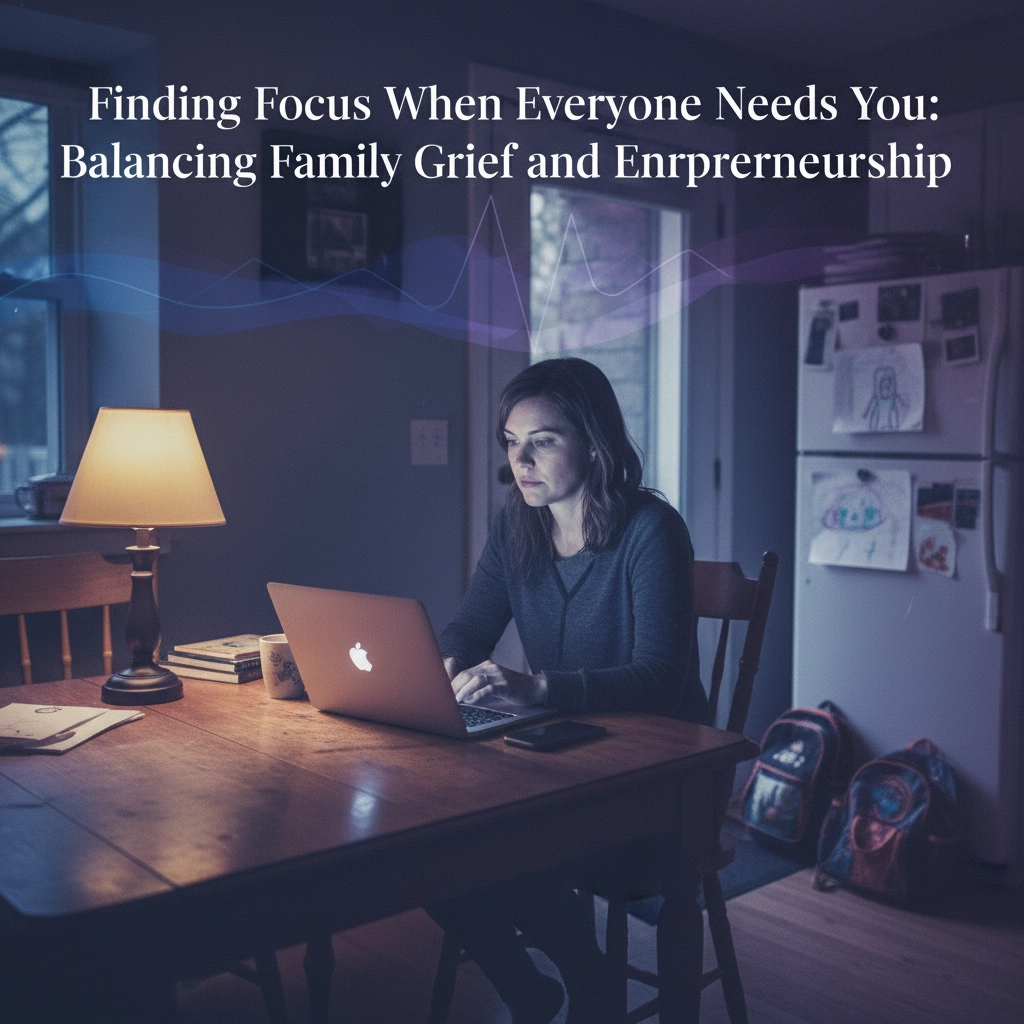
The cursor blinked back at me, mocking my inability to form coherent thoughts while my ten-year-old tugged at my sleeve asking when dinner would be ready and my thirteen-year-old called from the other room about homework and my phone buzzed incessantly with client messages. It had been three months since we lost my husband, and I was drowning in the impossible mathematics of grief: everyone needed me, my business required my attention, and I had nothing left to give.
If you're reading this, you know this feeling intimately. You understand what it means to be the CEO of your own company and the emotional anchor for your family simultaneously. You know the weight of being responsible for income generation while your children ask questions you don't have answers to, while your spouse processes their own grief differently than you do, while your business demands decisions from a brain that can barely remember if you've eaten lunch.
The hardest thing about balancing family grief and entrepreneurship isn't the workload, it's the guilt that follows you everywhere. Guilt when you're working and your child needs comfort. Guilt when you're comforting your child and emails pile up. Guilt when you take a moment to breathe because somehow, in that moment of stillness, you feel like you're failing everyone who depends on you.
The Cognitive Reality No One Talks About
Let me be brutally honest about something: grief brain is real, and it doesn't care about your business deadlines. Executive function takes a significant hit when you're processing loss. The same mind that used to juggle client calls, school pick-up schedules, and strategic planning now struggles to remember basic tasks. I found myself staring at my computer screen for twenty minutes, unable to recall what I was supposed to be working on, while the boys were at school and precious quiet time slipped away.

Your capacity isn't diminished because you're weak, it's diminished because your brain is doing the enormous work of processing trauma while simultaneously trying to keep your world functioning. Some days, functioning means everyone is fed and the most urgent client email gets answered. Other days, functioning means you managed to shower and didn't snap at anyone. Both are victories.
The grief waves don't follow your calendar. They don't care that you have a presentation at 2 pm or that your child has athletics at 4 pm. They crash over you in the middle of the weekly shop, during client calls, while you're helping with homework. And in those moments, everyone around you, your children, your clients, they all need you to be present, to be okay, to keep everything moving.
But honestly? Sometimes you're not okay. Sometimes keeping everything moving feels impossible.
Building Micro-Systems That Actually Work
Over time, I learned that the traditional business advice about delegation and systems wasn't built for solo entrepreneurs managing family grief. We don't have teams to hand things off to. We don't have the luxury of taking extended leave. We need micro-systems, tiny adjustments that create breathing room without requiring major infrastructure changes.
I started batching similar tasks during the kids' quiet hours. All client emails got answered during school hours or after bedtime.
It wasn't perfect, but it gave me permission to be fully present with my family during designated times without the constant background hum of business anxiety.
Emergency templates became my lifeline. Pre-written responses for common client questions. A simple email explaining when I'd be delayed in responding. Contact information for trusted colleagues who could handle urgent matters if I was truly unavailable. These took an hour to create but saved me countless hours of decision fatigue during the worst grief days.
Financial buffers matter more than anyone wants to admit. When your income depends entirely on your ability to show up and perform, and grief has made showing up unpredictable, having three to six months of expenses saved becomes less about financial planning and more about survival. It's the difference between panicking when you need a grief day and knowing your family will be okay if you need to step back temporarily.
The Permission You're Waiting For
Here's what I wish someone had told me earlier: you don't have to be everything to everyone all the time. Your children need a parent who is honest about struggling more than they need a parent who pretends everything is fine. Your clients need clear communication about your availability more than they need you to respond immediately while you're barely functioning.
The guilt of setting boundaries during grief feels overwhelming because it goes against every instinct we have as business owners and parents. We're conditioned to believe that success requires constant availability, that good parenting means always having the answers, that professional reliability means never saying no. But grief rewrites all these rules.

I started having honest conversations with my boys, aged 10 and 13, about difficult days.
Not the details of adult grief, but the acknowledgement that some days Mummy needed extra quiet time to feel better, and that was normal and temporary. They adapted better than I expected. Children are remarkably resilient when they understand what's happening rather than sensing unexplained tension.
With clients, I became more upfront about my availability. "I'm navigating the loss of my husband and may be slower to respond than usual, but I'll always let you know if I can't meet a deadline." Most people responded with understanding and patience. The few who didn't weren't clients I wanted to work with long-term anyway.
Finding Focus in the Fragments
Focus, during family grief, doesn't look like eight uninterrupted hours of deep work. It looks like twenty-minute pockets of concentrated attention between school runs and bedtime stories.
I learned to work with my grief brain rather than fighting it. On days when complex thinking felt impossible, I handled administrative tasks: filing, organising, responding to routine emails. On days when emotional processing demanded space, I let myself feel without forcing productivity. On rare days when mental clarity returned, I tackled the challenging strategic work that required my full attention.
The key was releasing the expectation that every day would be the same. Some days I worked for six hours while the kids were at school and felt accomplished. Other days I managed thirty minutes of scattered attention and considered it enough. Both were valid responses to the reality of grieving while building a business.
Time blocking became less about rigid schedules and more about protecting essential functions. Family dinner happened every night, even if it was takeaway. Bedtime stories continued, even when I was exhausted. Client deadlines were met, even if the work happened at midnight. But everything else: the perfect meals, the elaborate weekend plans, the networking events: became negotiable.

The Long Game of Healing While Building
Seven years later, I can tell you that balancing family grief and entrepreneurship changes you fundamentally. You develop a different relationship with perfection. You learn to communicate needs more clearly. You build businesses that can flex with life's unpredictability rather than breaking under pressure.
The grief softens but never completely disappears. Some anniversaries still hit hard. Some random Tuesday afternoons bring unexpected tears. But your capacity to hold both sorrow and business growth, family needs and professional responsibilities, expands gradually. You develop scar tissue that makes you stronger, not harder.
Your children learn resilience by watching you navigate difficulty with honesty and grace. Your business becomes more sustainable because you've been forced to build systems that don't depend on your constant presence. Your relationships deepen because shared struggle has a way of revealing what really matters.
But honestly? There are still days when everyone needs you and you have nothing left to give. The difference now is that I know those days are temporary. I know that asking for help isn't failure. I know that my boys remember the presence more than the productivity, and my clients value authenticity more than perfectionism.
Moving Forward, One Day at a Time
If you're in the thick of it right now: managing client demands while your child asks when Daddy is coming home, trying to focus on strategy while processing your own loss: know that you're stronger than you think. Know that survival mode is a legitimate business strategy when it's necessary. Know that your grief doesn't make you unprofessional, and your professional responsibilities don't minimise your loss.
Start small. Pick one tiny system to implement this week. Give yourself permission to have a mediocre day without judgment. Ask for help with something specific rather than suffering in silence. Your family needs you present more than they need you perfect. Your business needs you sustainable more than it needs you constantly available.
The balance isn't something you achieve and maintain: it's something you negotiate daily, sometimes hourly. Some seasons require more family focus. Some seasons allow more business growth. Both are temporary. Both are necessary.
You're building something beautiful in the midst of something broken. That's the heart of entrepreneurship, and it's the heart of healing. Trust the process, even when you can't see the outcome. Especially then.
Leave a Reply