Category: Conversations

  • Finding Focus When Everyone Needs You: Balancing Family Grief and Entrepreneurship

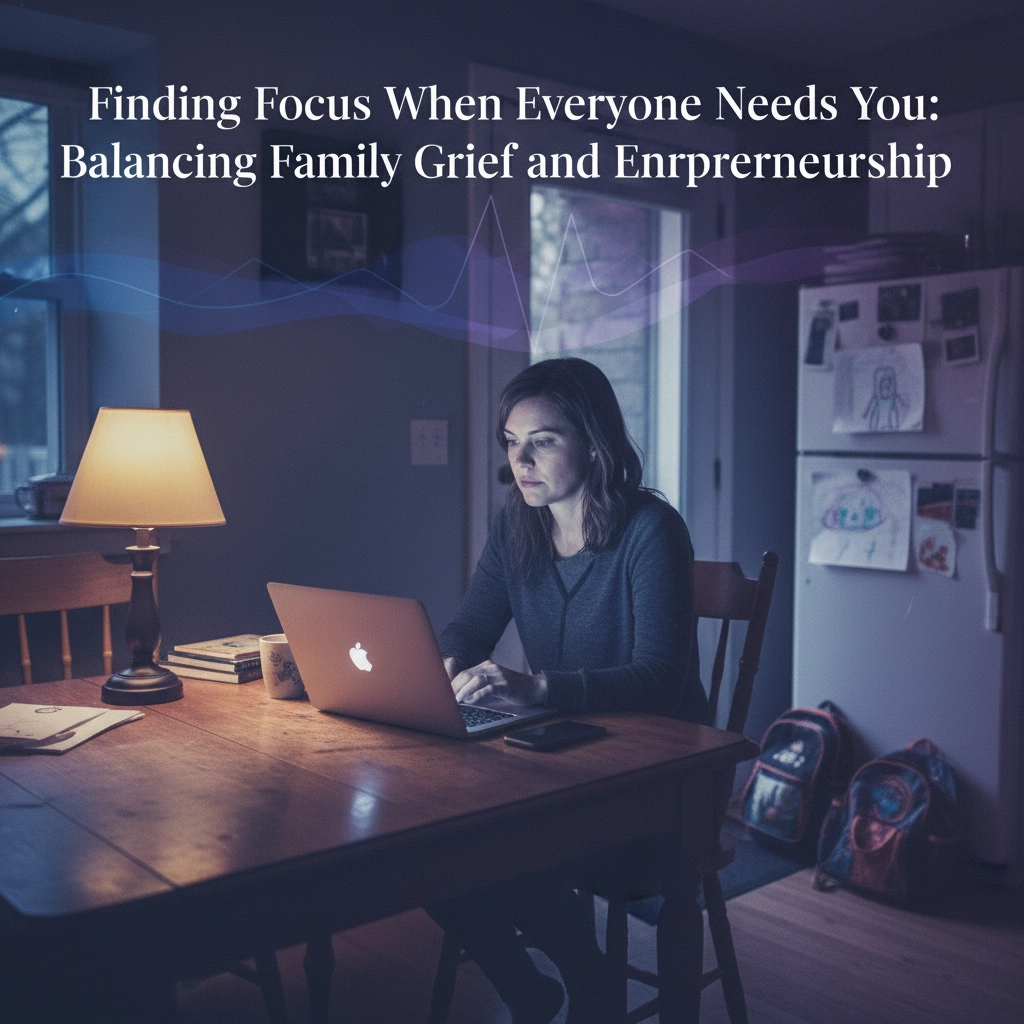
    Finding Focus When Everyone Needs You: Balancing Family Grief and Entrepreneurship

    The cursor blinked back at me, mocking my inability to form coherent thoughts while my ten-year-old tugged at my sleeve asking when dinner would be ready and my thirteen-year-old called from the other room about homework and my phone buzzed incessantly with client messages. It had been three months since we lost my husband, and I was drowning in the impossible mathematics of grief: everyone needed me, my business required my attention, and I had nothing left to give.

    If you're reading this, you know this feeling intimately. You understand what it means to be the CEO of your own company and the emotional anchor for your family simultaneously. You know the weight of being responsible for income generation while your children ask questions you don't have answers to, while your spouse processes their own grief differently than you do, while your business demands decisions from a brain that can barely remember if you've eaten lunch.

    The hardest thing about balancing family grief and entrepreneurship isn't the workload, it's the guilt that follows you everywhere. Guilt when you're working and your child needs comfort. Guilt when you're comforting your child and emails pile up. Guilt when you take a moment to breathe because somehow, in that moment of stillness, you feel like you're failing everyone who depends on you.

    The Cognitive Reality No One Talks About

    Let me be brutally honest about something: grief brain is real, and it doesn't care about your business deadlines. Executive function takes a significant hit when you're processing loss. The same mind that used to juggle client calls, school pick-up schedules, and strategic planning now struggles to remember basic tasks. I found myself staring at my computer screen for twenty minutes, unable to recall what I was supposed to be working on, while the boys were at school and precious quiet time slipped away.

    image_1

    Your capacity isn't diminished because you're weak, it's diminished because your brain is doing the enormous work of processing trauma while simultaneously trying to keep your world functioning. Some days, functioning means everyone is fed and the most urgent client email gets answered. Other days, functioning means you managed to shower and didn't snap at anyone. Both are victories.

    The grief waves don't follow your calendar. They don't care that you have a presentation at 2 pm or that your child has athletics at 4 pm. They crash over you in the middle of the weekly shop, during client calls, while you're helping with homework. And in those moments, everyone around you, your children, your clients, they all need you to be present, to be okay, to keep everything moving.

    But honestly? Sometimes you're not okay. Sometimes keeping everything moving feels impossible.

    Building Micro-Systems That Actually Work

    Over time, I learned that the traditional business advice about delegation and systems wasn't built for solo entrepreneurs managing family grief. We don't have teams to hand things off to. We don't have the luxury of taking extended leave. We need micro-systems, tiny adjustments that create breathing room without requiring major infrastructure changes.

    I started batching similar tasks during the kids' quiet hours. All client emails got answered during school hours or after bedtime.
    It wasn't perfect, but it gave me permission to be fully present with my family during designated times without the constant background hum of business anxiety.

    Emergency templates became my lifeline. Pre-written responses for common client questions. A simple email explaining when I'd be delayed in responding. Contact information for trusted colleagues who could handle urgent matters if I was truly unavailable. These took an hour to create but saved me countless hours of decision fatigue during the worst grief days.

    Financial buffers matter more than anyone wants to admit. When your income depends entirely on your ability to show up and perform, and grief has made showing up unpredictable, having three to six months of expenses saved becomes less about financial planning and more about survival. It's the difference between panicking when you need a grief day and knowing your family will be okay if you need to step back temporarily.

    The Permission You're Waiting For

    Here's what I wish someone had told me earlier: you don't have to be everything to everyone all the time. Your children need a parent who is honest about struggling more than they need a parent who pretends everything is fine. Your clients need clear communication about your availability more than they need you to respond immediately while you're barely functioning.

    The guilt of setting boundaries during grief feels overwhelming because it goes against every instinct we have as business owners and parents. We're conditioned to believe that success requires constant availability, that good parenting means always having the answers, that professional reliability means never saying no. But grief rewrites all these rules.

    image_2

    I started having honest conversations with my boys, aged 10 and 13, about difficult days.
    Not the details of adult grief, but the acknowledgement that some days Mummy needed extra quiet time to feel better, and that was normal and temporary. They adapted better than I expected. Children are remarkably resilient when they understand what's happening rather than sensing unexplained tension.

    With clients, I became more upfront about my availability. "I'm navigating the loss of my husband and may be slower to respond than usual, but I'll always let you know if I can't meet a deadline." Most people responded with understanding and patience. The few who didn't weren't clients I wanted to work with long-term anyway.

    Finding Focus in the Fragments

    Focus, during family grief, doesn't look like eight uninterrupted hours of deep work. It looks like twenty-minute pockets of concentrated attention between school runs and bedtime stories.

    I learned to work with my grief brain rather than fighting it. On days when complex thinking felt impossible, I handled administrative tasks: filing, organising, responding to routine emails. On days when emotional processing demanded space, I let myself feel without forcing productivity. On rare days when mental clarity returned, I tackled the challenging strategic work that required my full attention.

    The key was releasing the expectation that every day would be the same. Some days I worked for six hours while the kids were at school and felt accomplished. Other days I managed thirty minutes of scattered attention and considered it enough. Both were valid responses to the reality of grieving while building a business.

    Time blocking became less about rigid schedules and more about protecting essential functions. Family dinner happened every night, even if it was takeaway. Bedtime stories continued, even when I was exhausted. Client deadlines were met, even if the work happened at midnight. But everything else: the perfect meals, the elaborate weekend plans, the networking events: became negotiable.

    image_3

    The Long Game of Healing While Building

    Seven years later, I can tell you that balancing family grief and entrepreneurship changes you fundamentally. You develop a different relationship with perfection. You learn to communicate needs more clearly. You build businesses that can flex with life's unpredictability rather than breaking under pressure.

    The grief softens but never completely disappears. Some anniversaries still hit hard. Some random Tuesday afternoons bring unexpected tears. But your capacity to hold both sorrow and business growth, family needs and professional responsibilities, expands gradually. You develop scar tissue that makes you stronger, not harder.

    Your children learn resilience by watching you navigate difficulty with honesty and grace. Your business becomes more sustainable because you've been forced to build systems that don't depend on your constant presence. Your relationships deepen because shared struggle has a way of revealing what really matters.

    But honestly? There are still days when everyone needs you and you have nothing left to give. The difference now is that I know those days are temporary. I know that asking for help isn't failure. I know that my boys remember the presence more than the productivity, and my clients value authenticity more than perfectionism.

    Moving Forward, One Day at a Time

    If you're in the thick of it right now: managing client demands while your child asks when Daddy is coming home, trying to focus on strategy while processing your own loss: know that you're stronger than you think. Know that survival mode is a legitimate business strategy when it's necessary. Know that your grief doesn't make you unprofessional, and your professional responsibilities don't minimise your loss.

    Start small. Pick one tiny system to implement this week. Give yourself permission to have a mediocre day without judgment. Ask for help with something specific rather than suffering in silence. Your family needs you present more than they need you perfect. Your business needs you sustainable more than it needs you constantly available.

    The balance isn't something you achieve and maintain: it's something you negotiate daily, sometimes hourly. Some seasons require more family focus. Some seasons allow more business growth. Both are temporary. Both are necessary.

    You're building something beautiful in the midst of something broken. That's the heart of entrepreneurship, and it's the heart of healing. Trust the process, even when you can't see the outcome. Especially then.

  • The Solo Parent's Guide to Keeping Your Business Running Through Grief

    The Solo Parent's Guide to Keeping Your Business Running Through Grief

    The first work day after my husband died, I sat at my laptop at 5:47 AM, the cursor blinking back at me, mocking my inability to form coherent thoughts. My two boys were still sleeping, and the house felt impossibly quiet: the kind of quiet that makes you realise how much noise one person can make just by existing. I had three client deadlines that week, a rent payment due, and absolutely no idea how I was going to manage any of it.

    If you're reading this, you might be sitting in that same impossible space right now. The space where grief meets business ownership meets solo parenting, and everything feels like it's on fire at once. I want you to know that what you're feeling: that overwhelming sense that you can't possibly keep all these plates spinning: is completely normal. Your brain is literally working differently right now, and trying to maintain your pre-loss productivity will only compound the pain you're already carrying.

    The Reality Nobody Talks About

    Honestly, the hardest thing about those first few months wasn't just the grief itself. It was the crushing weight of realising that life expected me to keep performing at full capacity while my executive function had basically shut down. Grief doesn't pause for client calls or school pick-ups or quarterly reports. It just sits there, heavy and demanding, while invoices pile up and your business slowly starts to feel like another thing you're failing at.

    I remember one particular Tuesday: maybe six weeks after: when I spent forty-five minutes staring at an email I needed to send to a client about a project delay. Forty-five minutes. The words wouldn't come together properly, and I kept forgetting what I was trying to say halfway through sentences. This is what they don't tell you about grief brain: it steals your language first, then your concentration, then your confidence that you can handle anything at all.

    image_1

    But here's what I learned, slowly and painfully, over those first brutal months: accepting your changed capacity isn't giving up. It's survival strategy. The families who make it through this crisis intact aren't the ones who powered through like nothing happened. They're the ones who got realistic about what they could actually handle and asked for help early.

    The Communication That Saved My Business

    Three months in, I was drowning. I had two major projects running behind schedule, a client asking increasingly pointed questions about delivery dates, and my boys needed me to be present for their grief while I could barely manage my own. That's when I did something that terrified me: I told the truth.

    I sent an email to my biggest client explaining that I was managing my business as a widowed parent after losing my husband while navigating grief, and I needed their patience with some adjusted timelines. I was convinced they'd fire me. Instead, they extended my deadline by two weeks.

    This response taught me something crucial: most people want to help, they just don't know how or feel awkward bringing up sensitive topics. When you communicate transparently about your situation while reassuring clients that you're still committed to quality work, you often find grace where you expected judgement.

    But transparency requires energy you might not have, so here's what worked for me: I drafted a template email explaining my situation that I could customise for different clients. Having those words already written meant I didn't have to find them during my worst moments, when forming sentences felt impossible.

    Building Structure When Everything Feels Chaotic

    The morning routine saved us. I know that sounds overly simple, but hear me out. When your world has been turned upside down, both you and your children desperately need something that stays the same. For us, it became the ritual of breakfast together at 7:30, no phones, no work calls: just us and whatever small conversation my boys wanted to have.

    Those thirty minutes of predictability gave me an anchor point each day, something I could build the rest of my schedule around. I started scheduling my most demanding work during my boys' school hours, keeping afternoons free for the emotional labour that grief demands from children. They need space to ask questions, to cry unexpectedly, to just be held when the weight of loss hits them again.

    image_2

    I learned to batch similar tasks together during my peak energy hours: usually mid-morning when the grief fog was lighter. Answering all emails at once, making all my client calls back-to-back, handling administrative tasks in designated blocks. This wasn't just about efficiency; it was about protecting my mental resources for the moments when my boys needed me to be fully present.

    The Administrative Mountain

    Nobody prepares you for the administrative burden that comes with loss. In those first few months, I spent so many hours on tasks that had nothing to do with my business or my boys: death certificates, insurance claims, account closures, legal procedures. Every hour on hold with some company was an hour not spent earning money or comforting my boys.

    Our household income dropped by almost 40% immediately, but the time demands increased exponentially. This is the cruel mathematics of loss: less money, more bureaucracy, same bills. I finally hired a virtual assistant for ten hours a week, something I'd never thought I could afford. It turned out I couldn't afford not to.

    Having someone else handle routine business tasks: scheduling, basic correspondence, invoice follow-ups: gave me back hours I desperately needed for both grief work and actual revenue-generating activities. Some weeks, that assistant was the only reason my business didn't completely stall.

    When Work Feels Impossible

    There were days, especially in the beginning, when opening my laptop felt like trying to perform surgery with broken hands. Everything took three times longer than it should have. I'd read the same paragraph five times and still not understand it. I'd start tasks and forget what I was doing halfway through.

    On those days, I learned to focus on the absolute minimum: one email, one small project task, one step forward. Sometimes that's all you can do, and it has to be enough. The grief waves come without warning, and fighting them only makes everything harder.

    image_3

    I kept a running list of low-energy tasks for the worst days: things like organising files, updating my website, responding to non-urgent emails. When my brain couldn't handle complex problem-solving, I could still chip away at these smaller necessities. It helped me feel like I was moving forward even when everything felt impossible.

    Finding Your People

    The isolation hit harder than I expected. Most of my friends were couples with their own lives, their own complete families. I found myself hesitating to reach out, worried about being the sad friend who brought down the mood of every gathering.

    But connecting with other solo parents who understood this specific journey became essential. There's something powerful about talking to someone who doesn't need you to explain why you're crying in the supermarket or why bedtime stories make you heartbroken some nights. They just know.

    I found my people through online communities, local support groups, and honestly, some unexpected places. We'd text each other during hard moments, share resources, celebrate small victories that only we understood the magnitude of.

    The Long View

    Seven years later, I can tell you that the crisis phase ends, but the journey continues. My business not only survived but grew stronger because I learned to build systems that accounted for life's unpredictability. My boys and I developed a closeness that came from navigating something impossibly difficult together.

    But I want to be honest with you: it doesn't get easier, exactly. The grief changes shape, becomes less acute, but it never fully goes away. Some days are still hard. Some client calls still catch me off guard when they mention their spouse casually. The difference is that I'm no longer afraid of these moments. I know I can handle them.

    image_4

    The version of me who sat at that laptop seven years ago, paralyzed by the impossibility of it all, couldn't have imagined the strength that was growing in those dark moments. Every small step you take right now: every email you manage to send, every deadline you meet, every bedtime story you read while your heart is breaking: is building that strength.

    You are not failing. You are not behind. You are doing something incredibly difficult with grace, even when it doesn't feel graceful. Your love and presence mean everything to your child, and your determination to keep building a life that honours both your loss and your resilience is extraordinary.

    The cursor might be blinking at you right now, waiting for words that feel impossible to find. That's okay. Start with one word, then another. The business will survive. You will survive. And eventually, when you're ready, you might even discover that you've grown into someone stronger than you ever imagined possible.

    Know that you are not alone in this. Know that your struggle is seen and understood. And know that taking it one impossibly small step at a time is exactly how mountains get moved.

  • Building a New Normal: Simple Routines for Grieving Business Owners with Kids

    Building a New Normal: Simple Routines for Grieving Business Owners with Kids

    Seven months after my husband died and my world fell apart, I found myself standing in my kitchen at 6:47 AM, staring into space, Knowing that the cursor on my laptop blinked back at me from the dining table, mocking my inability to focus on the client work that was already three days late. This was my new reality, grief brain trying to run a business while small humans depended on me for everything from cereal to emotional stability.

    If you’re reading this, you probably know this particular kind of exhaustion. The bone-deep weariness that comes from holding it all together when everything inside you feels scattered like puzzle pieces after an earthquake. You’re not alone in this impossible juggling act, and honestly, most days I still feel like I’m dropping more balls than I’m catching.

    The hardest thing about grief when you’re a solo entrepreneur with kids is that there’s no pause button. There are no sick days from parenting, no extended bereavement leave when you are the business. The invoices still need to be sent, the school pick-up times don’t adjust for your broken heart, and somehow you’re supposed to figure out how to function when your executive function has taken a significant hit.

    In those first few weeks, I kept waiting for someone to tell me how to do this, how to rebuild a life that made sense when nothing made sense anymore. But grief doesn’t come with an instruction manual, and there’s no template for “how to parent and run a business when you can barely remember what day it is.”

    image_1

    The Morning That Changed Everything

    I remember the morning I realised I needed to stop waiting for normal to return and start building something new instead. We needed new rhythms, new structures that could bend without breaking when the grief waves hit unexpectedly.

    That afternoon, after I’d finally managed to focus long enough to finish that overdue proposal, I sat down with my kids and asked them a question that changed everything: “What do we need to feel okay right now?” Not perfect, not happy, just okay.

    The answers were simpler than I’d expected. My older son wanted to know he’d always have clean clothes for school. My younger son wanted to know there would always be food in the house, even if it wasn’t the meals I used to prepare. And honestly, I wanted to know that I could still be a good mum and keep my business afloat, even if both looked different than before.

    Starting Small: The Art of Micro-Routines

    The mistake I made initially was trying to rebuild everything at once. I’d create elaborate schedules that would last about three days before falling apart spectacularly. Over time, I learnt that grief-friendly routines need to be built like a house, foundation first, then walls, then all the pretty details that make it feel like home.

    We started with what I call micro-routines, tiny, non-negotiable anchors that could hold steady even on the worst days. Our first one was stupidly simple: every morning, no matter what chaos had happened the night before, I would make coffee and my kids would eat something that counted as breakfast.

    image_2

    The second micro-routine was equally modest: every business day, I would spend the first thirty minutes responding to urgent emails before the kids woke up. Not planning my entire day, not reviewing my quarterly goals, just clearing the most pressing fires so I wasn’t starting from a place of panic.

    These tiny routines became lifelines on days when everything else felt impossible. When grief brain made me forget parents’ evenings or client deadlines, at least I knew my kids had eaten and my most urgent work wasn’t completely neglected.

    The Reality of Flexibility

    But here’s what no one tells you about building routines while grieving: they need to be elastic. Static schedules work great when you’re operating at full capacity, but grief doesn’t follow anyone’s calendar. Some days you’ll wake up feeling almost normal, ready to tackle your to-do list with something resembling your old energy. Other days, the simple act of getting your kids dressed and yourself caffeinated will feel like climbing Everest.

    I learnt to create what I call “weather patterns” for my routines, different versions for different kinds of days. On sunny days, when grief was quiet and my brain was cooperating, I could handle the full routine: proper breakfast, organised workspace, scheduled client calls, after-school activities. On stormy days, when the wave hit hard, we had storm protocols: cereal for dinner, films instead of homework battles, work emails that simply said “I’ll get back to you tomorrow.”

    The key was recognising which kind of day it was early, before I exhausted myself trying to force a sunny-day routine on a stormy-day reality.

    Involving the Kids Without Overwhelming Them

    One of my biggest concerns was how much to share with my children about our changed circumstances. They’d lost someone too, they were dealing with their own grief, and now they were watching their mum struggle to keep everything together. I didn’t want to burden them with adult worries, but I also couldn’t pretend everything was fine when it clearly wasn’t.

    We found a middle ground that worked for us. I started including them in age-appropriate planning conversations. “Mum’s having a hard time remembering everything right now, so we’re going to make some lists together.” “Some days Mum’s work might take longer because my brain is moving slowly, so we need back-up plans for snacks and entertainment.”

    image_3

    This wasn’t about making them responsible for my emotional state or our household management, it was about making them partners in building something that worked for all of us. They felt useful and included rather than confused and helpless, and I got the support I desperately needed without the guilt of asking too much.

    The Business Side: Redefining Success

    Running a business while grieving with kids means redefining success in ways that might make your pre-grief self cringe. I had to accept that some months, just keeping the lights on was enough. Some client calls happened with background noise of sibling arguments or cartoons. Some projects took twice as long as they used to because I could only work in scattered fifteen-minute increments between emotional meltdowns, mine or theirs.

    I started being honest with my clients about my situation, not in elaborate detail, but enough context for them to understand why my communication patterns had changed. “I’m grieving the loss of my husband right now, so my response times may be slower than usual, but I’m committed to delivering quality work.” The response was overwhelmingly compassionate, and many clients shared their own experiences with working through difficult times.

    I also had to get comfortable with saying no to opportunities that would have excited my old self but felt impossible in my current reality. That speaking engagement that would have been great for my business but required overnight travel? Not right now. The client project that promised good money but demanded intense availability during after-school hours? Maybe next year.

    This wasn’t giving up on my ambitions: it was protecting the foundation I was trying to rebuild. Some seasons are for growth, and some seasons are for simply surviving with grace. Both have their place.

    The Non-linear Nature of Healing

    Two years on, I wish I could tell you that building these routines was a steady progression from chaos to order, from broken to whole. But grief doesn’t work that way, and neither does healing. There were days when I felt almost like my old self: efficient, organised, emotionally steady. Then something small: a song, a photograph, an innocent comment from one of the kids: knocked me sideways for hours or days. And even now, seven years on, there are still reminders that stop me in my tracks and transport me back to those days.

    The difference was that our routines could flex with these fluctuations. We had systems that work when I was operating at 90% capacity and different systems for when I was barely managing 30%. The kids knew that sometimes Mum needed extra quiet time to process feelings, and they had activities and snacks that didn’t require my constant supervision. I knew that some work days would be incredibly productive and others would consist mainly of moving emails from my inbox to a “deal with this tomorrow” folder.

    image_4

    This flexibility extended to how we defined family time and work time too. Sometimes family time looked like all of us in the living room, each doing our own thing but together. Sometimes work time happened at the dining table while the kids did homework beside me. The boundaries were softer, more permeable, and somehow that worked better for all of us than the rigid compartments I used to maintain.

    What I Wish I’d Known Then

    If I could go back to that version of myself standing in the kitchen, overwhelmed and exhausted and wondering how she was going to make it through another day, I would tell her this: Start smaller than you think you need to. Be kinder to yourself than feels reasonable. Ask for help earlier and more often than your pride wants to allow.

    I would tell her that building a new normal doesn’t mean accepting less than she deserves: it means creating something sustainable that honours both her grief and her responsibilities. I would remind her that her kids are more resilient than she fears and that they’re learning valuable lessons about flexibility, compassion, and what it means to keep going when life gets hard.

    Most importantly, I would tell her that there’s no timeline for this process. Some days will feel like progress, others like setbacks, and both are part of the same journey. The goal isn’t to get back to who she was before: that person lived in a different world. The goal is to become someone who can thrive in this new reality, carrying both the weight of loss and the possibility of joy.

    You’re stronger than you think you are, even when you feel weakest. Especially then. The routines you’re building now, imperfect and ever-changing as they are, are acts of love: for your children, for your business, for the life you’re creating from the pieces of the one that broke.

    And that’s enough. You’re enough. This messy, tender, resilient life you’re building (it’s enough.)

  • Untitled post 424

    The morning my life changed forever, everything I thought I knew about juggling motherhood and entrepreneurship became irrelevant. The grief that followed wasn’t just mine to carry, it belonged to my children too, and somehow, impossibly, the business still needed to run.

    If you’re reading this as a solo entrepreneur who’s also a parent, navigating the impossible intersection of grief, childcare, and keeping your business afloat, I want you to know something: you are not alone in this. And you are stronger than you think, even when, especially when, you feel like you’re drowning.

    The thing about grief when you’re a solo parent and business owner is that it doesn’t wait for convenient moments. It hits you during client calls, in the middle of helping with homework, or at 3 am when you’re finally trying to catch up on work. There’s no pause button, no neat schedule where you can compartmentalise the pain. And yet, somehow, we have to keep going.

    Over the past seven years since my world cracked open, I’ve learned some hard-won truths about surviving this particular kind of storm. These aren’t pretty, polished strategies from business school, they’re messy, imperfect lifelines that I wish someone had handed me in those first devastating weeks.

    1. Accept That Your Capacity Has Been Cut in Half (And That’s Okay)

    image_1

    I spent the first month after the loss of my husband trying to maintain the same pace, the same standards, the same everything. I was convinced that if I could just push through, if I could prove that grief wouldn’t defeat me, somehow that would make me stronger. What it actually did was make me sick.

    The hardest thing to accept was that my brain simply wasn’t functioning at full capacity. Executive function takes a significant hit when you’re grieving, and when you add the emotional and logistical demands of supporting children through their own grief, it becomes nearly impossible to think clearly about business decisions. I found myself staring at my computer screen for hours, the cursor blinking back at me, mocking my inability to form coherent thoughts.

    Your capacity isn’t just reduced, it’s fundamentally changed. The energy you once had for creative problem-solving, strategic thinking, and client management is now being channelled into simply surviving each day and helping your children do the same. This isn’t weakness; it’s biology. Your nervous system is in protection mode, and that’s exactly where it should be.

    I learned to cut my to-do lists in half, then cut them in half again. Those projects I’d been excited about? They could wait. That marketing strategy I’d been developing? Not urgent. The only things that mattered were keeping existing clients happy, maintaining cash flow, and making sure my children felt safe and supported. Everything else became optional.

    Honestly, accepting this reduced capacity felt like admitting defeat at first. But over time, I realised it was actually the most strategic decision I could make. By acknowledging my limitations instead of fighting them, I could focus my limited energy on what truly mattered rather than spreading myself so thin that everything suffered.

    2. Build Your Village Before You Need It (And Use It When You Do)

    The myth of the solo entrepreneur is exactly that, a myth. None of us do this alone, and when grief strikes, that support network becomes your lifeline. But here’s what I wish I’d known: you can’t build your village in the middle of the crisis.

    I spent years thinking I had to prove my independence, that asking for help was somehow admitting I couldn’t handle my responsibilities. Then life happened, and I realised that my stubbornness wasn’t protecting anyone, it was actually putting my family and business at risk.

    image_2

    Your village might look different from mine, but it needs to include people who understand both sides of your life. Other parent-entrepreneurs who get why you’re answering emails at the school pick-up. Business mentors who’ve been through their own losses. Family members who can step in with childcare when you’re having a rough day. Friends who will sit with you in the mess without trying to fix it.

    The key is being vulnerable enough to let people know what’s really going on. I learned to send emails that said things like, “I’m struggling with a personal loss right now and my response times might be slower than usual.” Almost without exception, the responses were filled with understanding, shared experiences, and offers of help.

    And here’s the thing about using your village: it’s not just about receiving help. Letting others support you gives them the gift of feeling useful during a time when many people feel helpless in the face of someone else’s grief. It’s actually a kindness to let them help.

    3. Create Sacred Boundaries (Even When Everything Feels Urgent)

    Before grief, I thought boundaries were about protecting my time. After grief, I learned they’re about protecting my sanity and my children’s emotional wellbeing. When you’re grieving and parenting and running a business, everything feels urgent, everything feels like it can’t wait. But the truth is, very little actually can’t wait.

    I had to learn to turn off my phone after 7 pm. Not just put it on silent, actually turn it off. Because grief makes you hypervigilant, and every notification felt like a potential crisis that needed my immediate attention. But my children needed to see that they mattered more than my inbox, especially when their world had already been shaken.

    image_3

    The boundaries weren’t just about work bleeding into family time. They were also about protecting the space I needed to process my own emotions. I learned to block out time each week, sometimes just thirty minutes, where I could sit with my feelings without having to be “on” for anyone else.

    Sometimes this meant saying no to opportunities that would have been perfect in different circumstances. I turned down onsite work, pushed deadlines where I could, and passed on projects that I would have jumped at before. Each no felt like I was letting people down, but each yes would have meant letting my family down instead.

    The hardest boundary to maintain was with my own expectations. I had to give myself permission to have bad days, to cry during client calls, to occasionally send emails that were shorter and more direct than my usual warm, conversational tone. I had to accept that “good enough” was actually more than good enough when you’re doing your best in impossible circumstances.

    4. Let Your Children See Your Humanity (Within Reason)

    As parents, we often feel like we need to shield our children from our own pain, to be the strong ones who have it all together. But grief strips away pretence, and honestly, trying to maintain a perfect facade while your heart is breaking is exhausting and ultimately unhelpful.

    I made the mistake initially of trying to hide my tears, to compartmentalise my grief so completely that my children wouldn’t be affected by it. What I didn’t realise is that children are incredibly perceptive, and they could sense that something was terribly wrong even when I thought I was hiding it perfectly.

    image_4

    The breakthrough came when my ten-year-old asked me why I kept pretending I wasn’t sad. That conversation changed everything. I learned to let them see that adults have big feelings too, that it’s okay to be sad, and that feeling sad doesn’t mean we’re broken or that they need to fix us.

    This doesn’t mean trauma-dumping on your children or expecting them to be your emotional support. It means being honest when they ask why you’re crying, letting them know that some days are harder than others, and showing them that people can be sad and still be capable, still be loving, still be present.

    When I had to take a business call while tears were still drying on my cheeks, I learned to say to my children, “Mummy needs to switch into work mode now, but I’m still feeling sad, and that’s okay.” They learned that adults can hold multiple emotions at once, that professional competence and personal pain can coexist.

    Your children watching you navigate grief while still showing up for your responsibilities teaches them resilience in a way that no amount of lectures about “being strong” ever could. They learn that life includes difficult seasons, that it’s possible to be sad and still function, and that asking for help is part of being human.

    5. Honour the Non-Linear Nature of Grief and Business

    Here’s what nobody tells you about grief when you’re running a business: it doesn’t follow quarterly review cycles. It doesn’t respect deadlines. It shows up on your most important client days and disappears when you finally have space to process it. The grief wave hits when it hits, and fighting it only makes everything harder.

    Seven years later, I still have days when grief ambushes me. It might be triggered by a song, a smell, an anniversary, or absolutely nothing at all. The difference now is that I’ve learned to work with it rather than against it.

    I keep a “grief day” protocol in my business toolkit. It includes template emails for rescheduling calls, a list of low-energy tasks I can do when I can’t concentrate. Having this plan in place means I don’t have to make decisions when my brain is foggy with pain.

    image_5

    Some days, my best work happens in the midst of grief. There’s a raw honesty that comes from pain, a clarity about what really matters, a tenderness in my interactions with clients who are struggling. Other days, grief makes me scattered and ineffective, and I’ve learned to recognise those days and adjust accordingly.

    The same is true for my children. Their grief doesn’t follow school schedules or bedtime routines. Some days they needed extra cuddles and shorter work hours. Other days they were resilient and adaptable, able to entertain themselves while I tackle important projects. And they’re growing into wonderful men.

    Along the way I’ve learned to build flexibility into everything: client contracts that acknowledge life happens, childcare arrangements that can expand or contract as needed, financial buffers that allow for reduced productivity during difficult periods. This isn’t pessimism; it’s realistic planning for a life that includes both joy and sorrow.

    The beautiful thing I’ve discovered is that businesses built to accommodate grief are actually stronger, more sustainable, and more compassionate than those built on the myth that we can maintain consistent productivity regardless of what life throws at us. Clients respect honesty about human limitations. Children learn that work can be meaningful without being all-consuming. And we learn that our worth isn’t tied to our output, even when: especially when: our output varies with our ability to cope.


    If you’re in the thick of it right now, if you’re trying to balance grief and parenthood and business responsibilities, know that it gets different rather than easier. The acute pain softens into something more manageable, like scar tissue forming over a wound. The logistical chaos eventually settles into new routines. Your capacity slowly rebuilds, though it may never look quite the same as it did before.

    You are not failing when you need to take longer lunch breaks to attend grief counselling. You are not inadequate when your children need extra attention and your business goals have to shift. You are not weak when you ask for help, when you cry during Zoom calls, when you need to turn down opportunities because your plate is already too full.

    You are human, dealing with an impossible situation with courage and love. And honestly, that’s more than enough.

  • How Do I Tell the Kids? Navigating the Impossible Conversation After Suicide

    How Do I Tell the Kids? Navigating the Impossible Conversation After Suicide

    How do I tell the children that yesterday was the last time they saw their Dad?

    This was a conversation I had to have on Monday, 7th May 2018, and it was, without doubt, the hardest conversation of my entire life, and I’ve had a few difficult conversations.

    Being faced with telling the boys that their Dad had decided to take his own life and we wouldn’t see him again was horrific. The words felt impossible to form, the responsibility crushing. Yet somehow, I had to find the strength to tell them.

    The Devastating Day

    I remember that morning with painful clarity. The shock; finding him, running to my neighbour for help, the call to the police, calling his parents, the number of police officers and medical teams, the sudden silence when they all finally left. My mind was barely functioning, toggling between numbness and overwhelming pain; yet through it all, I knew my children needed me more than ever.

    I wanted to keep them safe from the truth, to shield them from that life-changing knowledge, but I’ve always believed that being honest with them (at age-appropriate levels) is the right thing to do. This time, despite wanting to do otherwise, it was no different. Every fiber of my being wanted to protect them, to shield them from the brutal reality. But I knew that honesty, however painful, was the foundation they would need to begin processing their grief.

    It was made exponentially more difficult as I was also dealing with the shock of finding him and the aftermath that followed. The images were still fresh, the trauma still raw. How could I possibly support them through their grief when my own was threatening to consume me?

    But they deserved answers as to why their day wasn’t turning out to be the day they were expecting to have. They had woken up to confusion, to whispered conversations, to the absence of their father, suddenly being taken to the neigbours house to spend the day, instead of heading to the school fayre like they were expecting. They deserved to know why.

    Finding the Words

    So after everyone had left, I took a breath, took them to one side and had the most devastating conversation. I chose a quiet space, away from distractions. I sat them down where I could hold their hands, where I could pull them into my arms when the words hit.

    Through a vision filled with tears and a voice cracking with emotion, I reminded them that they were loved very much, and what I was about to tell them would be really hard to hear, but the mental illness that Dad had been living with for so long had finally won, and he felt that he couldn’t carry on anymore and had taken his own life and we wouldn’t see him again.

    The confusion followed by the hurt and devastation was the hardest thing to watch, especially when all of your instincts are screaming at you to protect them and shield them from hurt. My youngest looked confused, as if he couldn’t comprehend the words. My eldest understood immediately, his face crumpling with a pain no child should ever have to feel. They cried. I cried. We held each other in that first terrible moment of our new reality.

    The Days That Followed

    While that initial conversation was all we could cope with right then, I gradually filled in more detail one-on-one as they asked questions, and they both processed what happened at their own pace. There is an almost three-year age gap between them, and their understanding of the world and life, while similar, was also very different at ages 10 and 13.

    The days after that conversation blurred together. We moved through the motions of life; arranging the funeral, notifying schools, accepting casseroles and bunches of flowers from friends and neighbours who didn’t know what else to do. Through it all, my children’s questions continued, sometimes in torrents, sometimes in trickles.

    “Was Dad sad because of me?” “Could we have stopped him?” “Did he not love us enough to stay?” “Where is he now?”

    Each question felt like reopening a wound, but I answered as honestly as I could, always reassuring them that their father loved them deeply, that mental illness distorts thinking, and that his decision came from a place of pain, not a lack of love.

    Different Children, Different Needs

    Over the next few weeks/months/years, they both had questions, and we dealt with them in age-appropriate ways. If they were both together, then the detail was kept to a level suitable for my youngest, and I’d follow up with my eldest at a later stage when we were alone. My eldest wanted to know more details than my youngest, and with my youngest, it took him until about five years afterwards to ask for the details of how Dad actually died.

    My eldest needed facts. He wanted to understand the mechanics of depression, to know the timeline of events, to process logically what his heart couldn’t comprehend.

    My youngest processed his grief differently. His questions came randomly, often when we were doing something completely unrelated, as if the moment felt safe enough to venture into that painful territory.

    The Persistent Confusion of Young Grief

    For quite a long time, my youngest would ask what time Daddy would be home. I think it was made especially difficult as their Dad was a lighting designer for live events and would often work away from home. So, in those first few weeks, it was as if he was just away for work and not away for good.

    “Daddy’s coming home on Friday, right?” he would ask, and my heart would break all over again as I’d gently remind him that Daddy wasn’t coming back. Sometimes he’d nod and continue playing, sometimes he’d cry as if hearing it for the first time.

    Expecting His Return

    And honestly, even though I was the one that found him that day, I also felt that he would just walk through the door. Even after the funeral and knowing he was gone, there would be days when I’d hear a car door and would expect him to be coming through our front door. Then, the realisation would hit, and the grief wave would be overwhelming.

    That was me as an adult with more experience and comprehension of how horrible the world can be. Being a child thrown into the dark part of life that way must have been even harder to cope with. It was the first experience of death either one of them had had. And for it to be their Dad was devastatingly life-changing.

    Finding Support

    We couldn’t navigate this alone. Grief counseling became part of my routine. we talked about the help that was out there and support groups for children who had lost parents to suicide. Showing them they weren’t alone, that their complicated feelings were normal, made a huge difference

    At school, I made sure their teachers were aware of our situation. Some days, concentrating was impossible for them. Having supportive adults in all areas of their lives created a safety net that held us when I alone couldn’t.

    The Gradual Healing

    Healing didn’t come in a straight line. There were good days followed by terrible ones, progress followed by setbacks. Holidays and anniversaries were particularly difficult, reopening wounds we thought were beginning to heal. But slowly, gradually, we found a new normal.

    Seven years later, there are still moments of grief. My youngest finally asked for the details of how his Dad died, and I answered truthfully, preparing myself for the fallout of that knowledge. But he surprised me with his resilience, processing the information and integrating it into his understanding in a way that seemed to bring him a measure of peace.

    What I’ve Learned

    If you find yourself facing this impossible conversation, here’s what I’ve learned that might help:

    1. Be honest but age-appropriate. Children need truth, but presented in ways they can process.
    2. Answer questions as they come. Don’t force information they’re not ready for, but be prepared to answer when they ask.
    3. Reassure them constantly. They need to know they were loved, that it wasn’t their fault, that they couldn’t have prevented it.
    4. Allow all emotions. Anger, confusion, denial—all are normal responses that need space for expression.
    5. Seek professional help. This is too big to handle alone. Find therapists experienced in childhood grief and suicide loss.
    6. Take care of yourself. Your children need you stable and present, which means addressing your own grief too.
    7. Keep their father’s memory alive. Help them remember the person, not just the way he died.
    8. Be patient with regression. Children may temporarily return to earlier behaviors—bedwetting, clinginess, tantrums. This is normal.
    9. Prepare for grief to resurface. Developmental milestones often trigger new waves of grief as children understand their loss differently.
    10. Find community. Connect with others who understand this specific type of loss.

    It Will Get Better

    It will be one of the hardest things you have to face as a parent.

    You know your children, and you know how best to talk to them.

    They’ll come to you with different questions and thoughts, which quite often can come out of the blue. It’s so hard, and you might not want to answer at the time, but it’s important for them to understand, so be compassionate and answer as best you can. Come back to the question later if you need to, but always be honest and truthful and answer at an age-appropriate level. It’s crucial in the healing for all of you.

    Know that you are stronger than you think, that it is possible, and that you can and will come through the other side of this horribly dark time. There will be days when you won’t believe this—when the grief feels as fresh as it did that first day. But I promise you, those days become less frequent.

    Our family will never be the same. The absence of their father has shaped my children in profound ways. But they are also shaped by his presence in their lives, by the love he gave them, by the parts of himself that live on in them.

    They are resilient, compassionate, and deeply empathetic young men now. They understand the fragility of life and the importance of mental health in ways I wish they never had to learn. But they are moving forward, carrying their father with them but not being defined by his death.

    And if you’re reading this in the raw aftermath of your own loss, know that one day, you will be able to breathe again too. One breath, one day, one moment at a time. You will find your way through.